 Cetusprotocol
 combines pools with swap aggregation
Cetusprotocol is a decentralized exchange that combines concentrated liquidity pools and swap aggregation for token trading and liquidity provision. Its main trading interface focuses on Sui, with a separate Aptos version. Price-range liquidity, automated orders, vaults, and the CETUS and xCETUS tokens support different ways to trade, manage positions, and participate in the protocol.
Where does a Cetus swap get its liquidity?
The Super Aggregator draws on liquidity sources across Sui, including routes beyond Cetus's own pools. Pools hold the assets that support trades; the aggregator searches for ways to exchange the selected tokens. A route can involve several pools or split liquidity across paths. Its quoted output reflects the available liquidity and routing conditions for that request. A CLMM pool determines how price-range liquidity supports swaps inside that pool. Aggregation determines which supported sources a proposed trade can use.
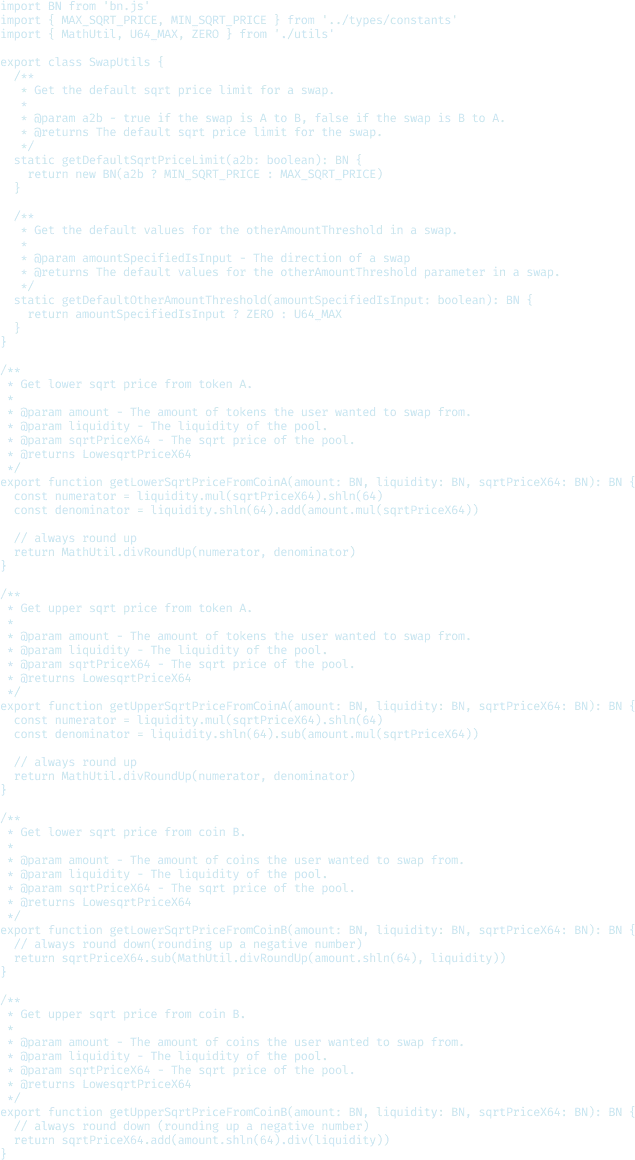
The aggregator's developer interface supports requests that fix either the input amount or the desired output amount. These modes describe different constraints, so an amount needs its input or output context. Supported providers and route options depend on the SDK version and request settings. A returned route remains a quote, and execution can encounter changed prices or unavailable liquidity.
Price ranges determine whether CLMM liquidity earns fees
A concentrated liquidity market maker, or CLMM, lets liquidity providers allocate assets between lower and upper price boundaries. A position participates in trading when the pool's price lies within that range. Outside it, the position becomes inactive and stops earning swap fees. Its token composition also changes with the price, becoming single-sided when fully outside the range.
Several positions can coexist in one pool with different ranges. Equal deposited values don't necessarily contribute equal active liquidity at a given price. Concentrated liquidity doesn't establish a fixed return. Trading volume and the position's share of active liquidity affect fee income. Changes in token prices affect the value of the assets that the position holds.
Fee earnings accumulate separately from the deposited liquidity in Cetus CLMM. A provider can claim those fees without withdrawing the underlying position, so collected fees and remaining liquidity describe different parts of the holding.
DLMM bins add a different pricing and fee model
Cetus's Dynamic Liquidity Market Maker, or DLMM, organizes liquidity into discrete price bins. Each bin has a fixed exchange price. Trading changes its token reserves without changing that bin's price; exhaustion of the relevant reserve moves trading to another bin. A trade that crosses bins can therefore encounter different prices, even though the price within each bin stays constant.
DLMM also combines a base fee with a variable component that responds to volatility and trading activity. This differs from selecting a CLMM pool with a particular fee tier. A fixed bin price doesn't remove trading fees or establish that a larger order can stay within one bin. The liquidity available along its path remains a constraint.
Swap amounts differ from pool fees and network gas
Input amounts use the token sold, while output quotes use the token bought. Quoted output divided by input expresses the quoted rate as units bought per unit sold.
The Cetus CLMM fee framework specifies a default protocol share of 20% of swap fees. That share divides trading fees between the protocol and liquidity providers. It isn't a 20% charge on the entire trade. The pool's selected fee tier determines the trading fee, while an active position's relative liquidity affects its fee allocation. Pools for the same pair can have different fee tiers and different amounts of available liquidity.
Network gas pays for blockchain execution, and some functionalities involve additional fees. Costs expressed in different tokens need a common valuation before their amounts can be added. Likewise, an estimated token output and a monetary estimate of gas describe different quantities. The selected route and product determine which charges need attention.
Slippage tolerance sets an acceptable deviation from the swap quote. It isn't another fee, and changing it changes the execution constraint. Prices and routes can change before execution, so a displayed output amount doesn't establish the amount that an executed transaction will deliver.
Direct positions and Cetus Vault use different ownership units
Direct liquidity provision gives the holder a position with its own range and liquidity amount. Cetus CLMM represents each position with a unique non-fungible token, or NFT. Its metadata identifies the pool and position boundaries. Liquidity management includes adding or removing assets and collecting fees or available incentives.
Cetus Vault automates liquidity management, including reinvestment of fees and rewards and rebalancing when necessary. The vault holds positions and uses deposits to supply their liquidity. Depositors receive LP tokens representing their share of liquidity within the vault. Those share tokens and a direct CLMM position NFT describe different ownership arrangements.
The proportion of the total LP token supply that a depositor owns determines their claim on vault liquidity. A share-token balance doesn't directly name an amount of either underlying asset. Token composition and vault liquidity are also needed to interpret that balance. Automation leaves exposure to asset-price changes and contract behavior. The choice between direct management and a vault concerns control over the position and its management.
What do limit orders and DCA change about execution?
Limit orders make trading conditional on a selected price, while DCA spreads purchases across a configured schedule. Cetus groups these products under Intent Trading. Both add execution settings beyond the token pair and amount, so a configured order carries different information from a swap quote.
A limit order specifies the assets, amount, price direction, target price, and expiry. Filling depends on market movement, liquidity depth, and order size. An order can fill partially, which separates the amount already purchased from the input that remains unfilled. Expiry and cancellation govern that remaining input.
Dollar-cost averaging, or DCA, uses a per-cycle input amount, execution frequency, and cycle count. The contract interface also includes minimum and maximum output amounts per cycle. Frequency uses seconds, while the cycle count specifies the intended number of executions. Scheduled purchasing leaves exposure to the token's market price and to the availability of the execution services.
CETUS and xCETUS connect participation with protocol rewards
CETUS is Cetus's transferable utility token on Sui. Liquidity mining can distribute it to qualifying participants. Holding CETUS doesn't confer ownership of the company that provides Cetus services. An incentive allocation is also separate from the token's market value, which affects what a reward is worth.
xCETUS is Cetus's escrowed staking token. Converting CETUS to xCETUS starts staking and makes the holder eligible for rewards. Rewards draw on net protocol fee earnings after commissions. Allocations differ between CLMM and DLMM, with a portion contributing to Sui Foundation loan repayment. Governance activation requires circulating CETUS to reach at least 90% of total supply.
Launchpad and developer tools extend the liquidity network
Cetus Launchpad supports token launches within the Sui ecosystem. Participation can use xCETUS balances to determine eligibility or buying quotas, subject to the event's rules. The wider Cetus ecosystem also includes incubation support for Sui projects through grant funding and technical, operational, and business assistance.
Developers can integrate liquidity through smart-contract interfaces, APIs, and software development kits, or SDKs. Cetus's Liquidity As A Service approach allows applications to incorporate trading or liquidity functions into their own products. Routing, pricing, and automation can use off-chain or hybrid infrastructure alongside on-chain settlement. Access through a contract and access through a hosted service therefore have different operational dependencies.
Sui hosts the main trading interface and the documented developer modules described here. Cetus also has a separate Aptos version. That distinction matters for wallet compatibility and network-specific deployments. Product availability and supported connections follow the selected network and version. Integrations also require monitoring applicable contract, SDK, and API updates and testing changes before production use.
The pool exploit makes contract security a material consideration
Cetus CLMM pools suffered an exploit in May 2025 involving a dependent software library. The attack disrupted pool balances and prices. The subsequent recovery program included patching the vulnerability, restoring pool data, recovering assets, and arranging compensation for affected users.
The June 2025 recovery plan combined partial refills of affected pools with a separate CETUS compensation allocation. Restored liquidity and compensation tokens describe different assets and entitlements.
Open-source contracts and security audits support scrutiny of the implementation. They don't eliminate vulnerabilities in contract code or its dependencies. Liquidity deposits expose assets to those contracts, while aggregation can introduce other liquidity sources and infrastructure into a route. The applicable contracts and service dependencies vary with the selected route or product.
Market movement affects position value, and network failures or interrupted routing services can affect execution. Wallet access and credentials also require protection because users authorize transactions through their own wallets. A quoted route or configured order supplies no promise of uninterrupted service.
Choose the product with its operating conditions in view
A swap exchanges tokens, while a direct position or vault deposit supplies liquidity. Choosing a feature starts with the action required and the conditions attached to it.
- Match the selected network and token identifiers to the intended assets.
- For an aggregated swap, examine quoted output, routing conditions, slippage tolerance, and applicable fees.
- For a CLMM position, relate the current pool price to its lower and upper boundaries.
- For a limit order or DCA order, examine the price or schedule and its execution constraints.
- Before converting CETUS into xCETUS, account for the redemption delay and conversion terms.
Choose between executing a quoted swap, setting an order, managing a direct position, or depositing into a vault.
Cetusprotocol: the short answers
-
Can xCETUS be sent to another wallet?
- xCETUS is non-transferable, so it can't be sent between wallets like CETUS. It represents escrowed participation in the protocol, with separate conversion and redemption rules.
-
How does a shorter xCETUS redemption period affect the amount received?
- A shorter xCETUS redemption period returns less CETUS under the documented vesting schedule. The 15-day minimum returns 0.5 CETUS per xCETUS; the 180-day maximum returns 1 CETUS per xCETUS. CETUS becomes available only when vesting ends. With a shorter period, the remaining portion is forfeited and transferred to the Eco Treasury.
-
Does selecting the market price make a Cetus limit order fill immediately?
- Selecting the displayed market price doesn't make a limit order execute immediately. The price feed can be outdated, particularly for less frequently traded pairs, and the market can change after selection. Execution follows the order's trigger conditions and sequence.
-
What happens to the unfilled amount when a Cetus limit order expires?
- An expired limit order automatically cancels and returns its unfilled input amount. That amount is distinct from tokens already purchased through partial fills. While a partially filled order remains open, the purchased amount can stay on-chain for manual claiming; a fully filled order distributes the purchased amount to the wallet automatically. Cancellation also distributes any unclaimed purchased tokens to the user.
-
Are charges refunded when a Cetus transaction fails?
- Cetus's service terms treat fees as non-refundable unless an explicit exception applies. A failed or reverted transaction doesn't by itself establish a refund entitlement. Network fees and charges for particular functionalities are separate cost categories. Whether an attempt incurred a charge depends on the transaction and network rules, so the transaction status alone doesn't identify the amount paid.
-
Will connecting a wallet give Cetus custody of its assets?
- Cetus provides its services without taking custody of users' digital assets. Transactions operate through blockchain networks under wallet control. That custody model doesn't remove the effects of an authorized swap or liquidity deposit, and pooled assets still face contract vulnerabilities. Users remain responsible for wallet credentials and for the transactions that they authorize.